
Articles

Camellia in January by Mike Darcy


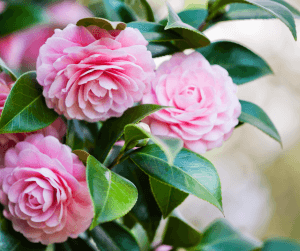
Sometimes I hear gardeners lament the lack of winter color in gardens but in the western part of the Pacific Northwest, there should be no complaints.  It is difficult to find a plant that can provide more winter color than the Camellia. While most are unscented, it is difficult to think of a winter blooming plant that can provide such diversity. With flower colors ranging from shades of red, pink, cream, and white, as well as many that are variegated and with blooms that can be single or double, the choices are vast. Plus, a big benefit to gardeners is that they are easy to grow.


Due to their diversity, it should come as no surprise that Camellias have different blooming periods depending on the particular type. With the winter season upon us, I am going to focus on Camellia sasanqua which are generally winter bloomers. A few of these Camellias will be highlighted but a visit to your local garden center will provide an idea of what is locally available.


While there are some very large Camellias in older established neighborhoods that are planted with no sun protection, I think they perform best with some shade, especially protection from the hot afternoon sun. Planting in a location with morning sun or filtered sunlight from trees is ideal. Some plants can grow into quite large shrubs so be sure to check the plant label as to height and width.


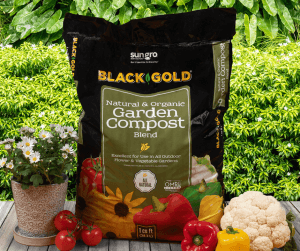
Camellias like to be planted in a soil that is moist and well-draining. Black Gold® Natural & Organic Cocoblend Potting Mix would be an ideal potting mix to work into the soil at time of planting. The coir, (coconut fiber) in this mix has excellent high water holding capacity qualities. Generally, Camellias are not deep-rooted plants and a yearly addition of a top dressing around the plant with Black Gold® Natural & Organic Garden Compost Blend would be a benefit.


There are many selections of Camellia sasanqua to choose from and I’ll mention several that I have grown or know friends that have. This season seems to have been and continues to be an extremely prolific blooming year.

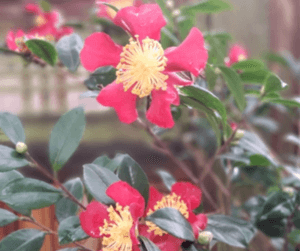
Yuletide is a Camellia sasanqua, so named because it is usually at bloom during the Christmas season with red single flowers. It is one of the most popular of the winter blooming camellias. Yuletide’ also makes an excellent container plant and having one at an entryway can brighten a gloomy winter day. To add even more color, try planting white pansies around the base.

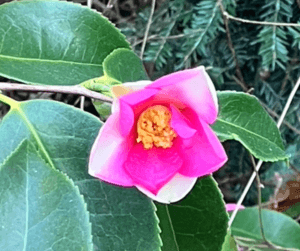
Showing off the diversity in flowers, a popular Camellia sasanqua that is multi-colored is ‘Yume’. This has single pink and white petaled flowers, each petal is either pink or white. It has a long winter flowering season with blooms appearing in November and continuing until March.

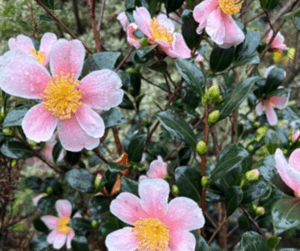
Another popular one and with a name that makes me smile is Camellia sasanqua ‘Pink-A-Boo’. This camellia, unlike most, has fragrant flowers. The pink flowers have bright yellow stamens and typical glossy, dark green foliage. A friend has had this growing in his garden for about ten years and it is about five feet in height and provides a nice ‘pop’ of winter color amongst other evergreen shrubs.


About Mike Darcy


Mike lives and gardens in a suburb of Portland, Oregon where he has resided since 1969. He grew in up Tucson, Arizona where he worked at a small retail nursery during his high school and college years. He received his formal education at the University of Arizona where he was awarded a Bachelor of Science Degree in Horticulture, and though he values his formal education, he values his field-experience more. It is hard to beat the ‘hands on’ experience of actually gardening, visiting gardens, and sharing information with other gardeners. Mike has been involved with gardening communications throughout his adult life. In addition to garden writing, he has done television gardening shows in Portland, and for over 30 years he hosted a Saturday radio talk show in Portland. Now he writes, speaks, gardens and continues to share his love of gardening. To be connected to the gardening industry is a bonus in life for Mike. He has found gardeners to be among the friendliest and most caring, generous people. Consequently, many of his friends he has met through gardening


Climbing Wonders


Climbing Wonders

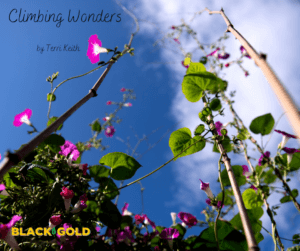
In the heat of the summer, here in the Midwest, many of the most beautiful, flowering garden vines are blooming their hearts out.  When I go out on the back deck, the Morning Glories (Ipomoea) are about to start opening their large trumpet shaped flowers, which will last until frost.  Morning Glories are native to Mexico, and were thought to have spirits by Native Americans.  The first one to become popular in modern times is ‘Heavenly Blue’. Some years ago, I planted ‘Heavenly Blue’ in one of my gardens.  Morning Glories reseed, and after a few years, I had pink, dark blue, purple and magenta flowers, coming up every year. Now seeds are available in all these colors, plus red, white and yellow, some with stripes.

Morning Glories are annuals that flower from early summer to frost.  Plant them in full sun, in any well drained, soil and keep the soil moist.  Soak the seeds for 8 hours, in ½-inch water, before planting.   Find a trellis, a fence, or a pole, to give them something to climb.

Hummingbirds and bees will be happy if you plant Morning Glories, but deer will not.

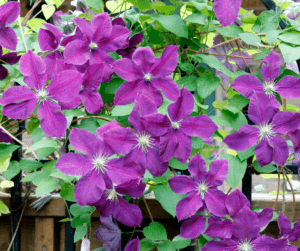
Clematis have been popular since 1862, when Clematis jackmanii, a purple flowering vine, was discovered in the Orient.  Since then several hundred varieties have been developed, with colors including blue, pink, white and deep red.  Most of them are single star shaped flowers, but some have gorgeous puffs, such as ‘Taiga’, a winner at the famous Chelsea Garden Show in 2017, with bright purple blue flowers, and centers of, white tipped petals that curve in.  ‘Rouge Cardinal’, another beauty, has 4 to 6 inch wide flowers of red with small white centers, and I even have one with small, blue, bells, ‘Roguchi’. Clematis is a perennial, and will come back every year on its own.  They range from 3 to 20 feet long, and can be trained along a fence, or trellis.  Plant in full sun, well-drained soil, with the crown 2 inches, below the surface.  Clematis are deer resistant.

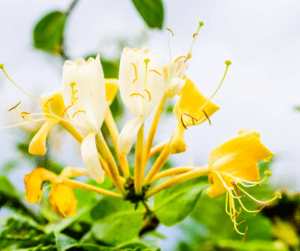
Honeysuckles (Lonicera) are an old-fashioned favorite.  They have a strong, sweet fragrance, as well as beautiful, tube shaped flowers.  There are two kinds of Honeysuckle plants, shrubs and vines.  One of the shrubs, Lonicera japonica, has become invasive, around the world.  Vines, however, are not a problem, and there are some gorgeous varieties. The Coral Honeysuckle varieties are native plants.  The flowers are fan shaped, and face down.  ‘Major Wheeler’ is covered with red and gold flowers all summer long.  It grows 6 to 8 feet tall and 5 to 10 feet wide.  ‘Goldflame’ has bright rose buds that open to yellow flowers, on 10 to 15 foot tall, and 5 to 6 foot vines and ‘Scentsation’s flowers, are yellow and white, and are extremely fragrant. It gets 10 feet tall, and 6 feet wide. Honeysuckles are one of the humming bird’s favorite flowers, and are deer resistant. Plant in full sun, in well-drained soil.

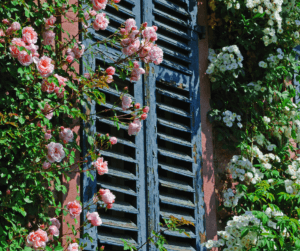
Last, but the best, are climbing roses.  You do not often hear about climbing roses here in the US, but they are common in Britain. You may have seen them, clambering up  English cottages, in British TV shows, like Midsomer Murders, or Downten Abbey, but these roses would only bloom in spring.  Seventy years ago, an English rose breeder, named David Austin, began cross breeding these roses with Chinese roses that bloom all season. The results are spectacular.  Most range from 6 feet, up to 12 feet, but some are even taller. They have a classic English rose shape, with an outside layer of flat petals, and a thick, bowl shaped, packed center, you will not see in the US.  They come in every color, white, pink, peach, rose, yellow and red.  Most have a strong fragrance as well.  These roses have been available in America for many years. Just go online, or order a catalog.  Some of my favorites include, ‘Gertrude Jekyll’, pink, ‘Lady of Shalott’, peach, ‘Zepherine’ deep rose, ‘Tess of the D’Urbervilles’, red. Plant with the crown at ground level, in a hole a little bit bigger then the plant.

For best results, with all garden plants, dig the hole, put a generous amount of Black Gold® Garden Soil in the bottom, then mix some more in the soil you are putting back into the hole.  Sprinkle with Osmocote on the top, and find a place to plant a climber.


About Teri Keith


Garden columnist, Teri Keith, has gardened for over 50 years in her home state of Indiana. She served as a longtime IGC nursery manager specializing in annuals and perennials in Bloomington, Indiana and still gardens with passion. Each year she plants and maintains over 50 flower containers, many gardens, and a large collection of lilacs.

Cultivate’20 Virtual

Sun Gro and Black Gold will attend the free Cultivate’20 Virtual presented by American Hort. It will be held online from July 13 to July 16, 2020. Visit our virtual 3D exhibit booth, enjoy seeing many speakers, take part in virtual networking events, and lots of educational opportunities. It promises to be a truly exciting online event for the green industry. Don’t miss it!

“For nearly 100 years, Cultivate has been known as THE event for every segment of the green industry. As the source of best practices, new plant varieties, and product innovation, Cultivate’20 Virtual is the place to network with old colleagues and meet new ones.”

Can You Recommend the Best Soils For My House Plants?

Best Soils For My House Plants

“I recently purchased a few house plants and would like to know what soil is best for them that you sell. What are the best soils for my house plants?” Question from Amanda of Leduc, Alberta, Canada

Answer: Here are our potting soil recommendations for each plant.

Aloe (Aloe spp.): Black Gold Cactus Mix – ideal for all succulents and cacti

Bird’s Nest Fern (Asplenium nidus) – Black Gold Waterhold Cocoblend – holds moisture well, which is perfect for ferns

Peace Lily (Spathiphyllum spp.) – Black Gold Waterhold Cocoblend – holds moisture well, which peace lilies prefer

Money Tree (Pachira aquatica) – Black Gold All Purpose Potting Mix – has just the right balance for money tree

ZZ Plant (Zamioculcas zamiifolia) – Black Gold Cactus Mix – a potting soil with good drainage is required

Sago Palm (Cycas revoluta) – Black Gold All Purpose Potting Mix

Lavender (Lavandula spp.): Black Gold Natural & Organic Potting Mix – drains well and is OMRI Listed for edibles

I hope that this information helps!

Happy indoor gardening,

Jessie Keith

Black Gold Horticulturist

Black Gold, Growing Organically to Meet Demand

Black Gold, is growing organically to meet demand. We have added four new products to our already strong line of Black Gold that are OMRI Listed for organic gardening. These products include Black Gold Natural & Organic Ultra Coir, Black Gold® Natural & Organic Flower and Vegetable Soil, Black Gold® Natural & Organic Raised Bed & Potting Mix, and Black Gold Natural & Organic Ultra Outdoor Planting Mix. Let us help you garden better naturally and organically with Black Gold.


Black Gold® Earthworm Castings Blend

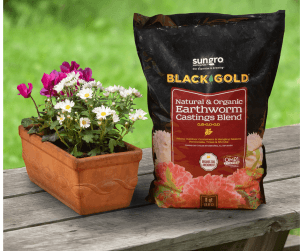
Black Gold® Earthworm Castings Blend gives gardeners a natural way to feed their soil and their plants. Enrich all of your garden plantings with fertile, nutrient-rich Black Gold® Earthworm Castings Blend. Use of to fortify vegetable gardens, containers, and flower beds. It is OMRI Listed for organic gardening, so you know that it is a safe, fertile choice for your family’s garden.

Click here for an informational pdf.

Black Gold® Perlite

We process premium Black Gold® Perlite for horticultural use, so it can be used and enjoyed by the everyday gardener. Use it as a potting soil amendment to increase the porosity and drainage of mixes, or use it alone to propagate plant cuttings. Black Gold® Perlite is also OMRI Listed® for organic gardening, so amend your favorite potting mixes with confidence.

Click here for an informational pdf.

January: MANTS 2020

Check us out at Booth 242!

Black Gold and Sun Gro Horticulture will be at The 2020 Mid-Atlantic Nursery Trade Show (MANTS), The Masterpiece of Trade Shows. Now in its 50th year, this business-related trade show for the horticulture industry hosts nearly 1000 exhibiting companies and supports over 11,000 annual registrants. The huge event covers over 300,000 square feet at the Baltimore Convention Center. It will be held from January 8-10, 2020.